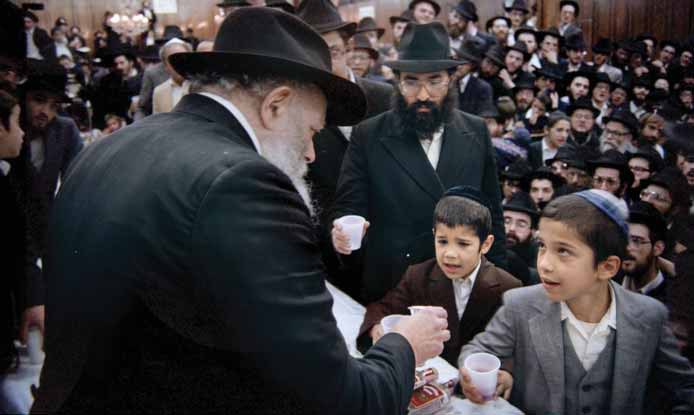
Kos shel bracha. Nachmi Deitsch as a boy, taking a cup from the Rebbe —
beside him his brother, Rabbi Levi, and behind them their father,
Rabbi Zalman Yuda Deitsch a”h, whose ten pages a day the son would take up
and carry, thirty years later, to the end of all forty‑two volumes.
Photograph as published in Beis Moshiach 1515.
Report · from the pages of Beis Moshiach
הדרן עלך, אגרות קודש
Hadran Alach, Igros Kodesh
One shliach in Toronto has just made a siyum on the entire Igros Kodesh — all 42 volumes, more than fifteen thousand letters — at ten pages a day, held for roughly thirty years. He learned the method from watching his father’s bookmark move.
Reported by Avrohom Reinitz·י’ מנחם‑אב ה’תשפ”ו·Beis Moshiach 1515
The article
Avrohom Reinitz, “הדרן עלך, אגרות קודש” (“Hadran Alach, Igros Kodesh”),
Beis Moshiach, issue 1515, י’ מנחם‑אב ה’תשפ”ו
(10 Menachem Av 5786 / 24 July 2026), pp. 17–23. Hebrew.
An interview with Rabbi Nachmi Deitsch, shliach in midtown Toronto.
What follows is our report on that article — not a translation of it. Passages from the
Rebbe’s letters are summarised in English and linked to the verbatim text in this library
rather than re‑quoted here.
A siyum of a different kind
The Nine Days are the season of siyumim, and by the Rebbe’s instruction they are made
everywhere. The one Reinitz reports on is a different order of thing. Not a tractate learned over recent
months — a study project that ran for about thirty years, and ended this summer with the whole of the
Rebbe’s Igros Kodesh: 42 volumes, upward of fifteen thousand letters.
Volume 42, carrying letters and answers from 5751–5752, appeared roughly a month before
the article. With it the circle closed for Rabbi Nachmi Deitsch, who in 5747 — then a young bochur —
took on a fixed seder of ten pages a day and simply kept it, six or seven days a week, volume after volume,
to the end. He made the siyum at the family gathering in Crown Heights marking the twentieth yahrzeit of his
father.
Where the seder came from
The idea was his father’s. R’ Zalman Yuda Deitsch a”h ran a substantial textile
warehouse business with partnerships abroad, and organised his life around learning anyway: every morning in
770 learning maamarei Admur haRashab with a chavrusa, davening b’minyan, and only then out to work —
plus a standing chavrusa in the Rebbe’s Torah through which he covered most of the maamarim and sichos
over the years.
In 5747, shortly after a new volume of Igros Kodesh came out, the son noticed how far his
father’s bookmark had travelled from one day to the next, and realised he was nearly through the book.
“I asked him: how do you read so fast? He answered simply — if every day you set
aside a certain time and read a certain number of pages, in a short while you can finish the book.”
He opened the volume and did the arithmetic: three hundred-odd
pages, ten pages a day, one volume a month. He started on the twenty-odd volumes then in print and kept
going. When he caught up with what had been published he moved to the Igros Kodesh of the Rebbe Rayatz and
the Rebbe Rashab, so that even between volumes the seder never broke.
Ten pages, and what makes them hard
The difficulty, he says, was front-loaded: volumes 1 and 2 carry a great deal of learned
material — a full kuntres on techiyas hameisim, letters on hashgacha pratis. The later volumes, from the
5740s on, go faster, being mostly matters of askanus and hadrachos in avodas Hashem and daily life rather
than lamdanishe correspondence. The target stayed at ten pages: sometimes twenty minutes, sometimes
three-quarters of an hour.
His father’s working rule was: don’t get stuck. Note the roshei teivos and keep
moving; ask afterwards. Page numbers and abbreviations accumulated at the back of each volume, and father and
son would go through the lists together. Later the questions went to his cousin, R’ Yitzchok Tannenbaum,
rosh yeshiva in Morristown. In the last decade WhatsApp has made it easier — photograph the line, get an
answer in minutes — but Rabbi Deitsch makes a point of not touching the phone for the first hour or
hour-and-a-half after rising. When he hits a question during the morning learning he writes it on a slip and
sends it later.
Asked whether ten pages is the only workable rate, he is emphatic that it is not: two or three
pages a day is a real seder, and he mentions a friend’s father-in-law who has long done six. Each person
and his own pace.
What fifteen thousand letters look like from the inside
Reading the letters in order, year by year, shows what is burning for the Rebbe in each
period — a stretch dense with letters on the mivtzoim, a stretch on shleimus ha’aretz, a stretch on
giyur and Mihu Yehudi, on shlichus, on asei lecha rav. The Rebbe is answering everything else in
parallel, but there is a thread running through, and reading sequentially you feel it.
Often a letter sends you back to the farbrengens: the Rebbe writes “as was discussed
this past Shabbos,” and to understand the answer you have to go and read the sicha. Reinitz records
Rabbi Deitsch’s example — a letter of 12 Kislev 5750 to Rav Pinchas Feldman, who had written that
he needed chizuk, answered sharply, with the added note that this was the year 5750, the year of
לב לדעת.
“You see what people wrote to the Rebbe and how they wrote it, what was troubling them
— and on the other side, the Rebbe’s particular attention to each one. With each person the Rebbe
corresponds in that person’s own language, about what that person needs.”
The Munkatcher in the warehouse
His father kept the seder at the office too, stealing a few minutes between deals. One day a
Munkatcher chassid came in to buy textiles. What kind of chassid are you? Munkatcher. — A Munkatcher
chassid! I have just been reading a letter the Rebbe wrote to a Munkatcher chassid.
He took down volume 21 and showed him. In a letter from the end of Tishrei 5712 the Rebbe
sends a New Year blessing to the recipient and his wife, and instructs him to picture from time to time the
image of his rebbe — the author of the Minchas Elazar — and to occupy himself with providing for
others in ruchniyus, and the Almighty will provide for him amply in both.
The customer said it was the most astonishing thing he had ever heard: he was the son of the
man the letter was written to. The volume went home with him as a gift.
The article does not name him; our copy of the letter does. The recipient is
R’ Pinchas Estreicher, and the letter was received through R’ Menachem Zev
Greenglass. Volume 21, printed page 135 —
read it in this library →
“Dos iz Lubavitch”
On one of his first Shabbosos on shlichus in Toronto, Rabbi Deitsch walked to one of the small
downtown shuls left over from earlier generations. Between tefillos someone threw out the question: what does
Lubavitch need to come here for? Before he could answer, a man of about seventy stood up — R’
Sholom Langer, a grandson of the Stretiner Rebbe — and said: if you want to know why Lubavitch came
here, let me tell you who Lubavitch is.
On the morning of 11 Shevat 5710 he had bought a newspaper on the street and seen the front
page announcing the Lubavitcher Rebbe’s histalkus. He brought it to his father, R’ Shlomo Langer,
who looked at the headline and sighed: if the Lubavitcher Rebbe has gone, it is a sign that Chaim Silver is
going to go.
The connection went back eight years. In 5702 Chaim Silver of Toronto lay unconscious with a
grave illness and the doctors had given up. His wife came to R’ Shlomo — your father is the
Stretiner Rebbe, can you bless my husband? R’ Shlomo answered that he was not a rebbe, but that the
Lubavitcher Rebbe had recently settled in Brooklyn, and he would telephone. The answer came back in the
Rebbe Rayatz’s name: Tomchei Tmimim had just been established in nearby Montreal; if the family would
undertake to give a thousand dollars to the yeshiva it would stand as a blessing for the sick man — a
malach made of a hundred not being the same as a malach made of a thousand.
A thousand dollars in 5702 was an enormous sum; Reinitz notes for scale that the 770 building
itself had been bought a few years earlier for thirty thousand. The patient’s brother and business
partner refused outright. His wife settled it — this is my husband — and the money was
sent. Days later Chaim Silver opened his eyes, sat up, and recovered completely.
Now, said R’ Shlomo in 5710 with the morning paper in his hand, the blessing had been the
Lubavitcher Rebbe’s. If the Rebbe has gone… A few weeks later Chaim Silver fell ill and passed
away. Nearly fifty years to the day after that morning, his son stood in the small Toronto shul and finished
in Yiddish: dos iz Lubavitch.
The letter waiting under the bookmark
The next morning was Sunday. Rabbi Deitsch sat down to his ten pages, opening as always at the
bookmark — and the first letter on the page was addressed to R’ Shlomo Langer of Toronto.
In 5724 R’ Shlomo had written the whole episode up and sent it to the Rebbe. The letter
under the bookmark was the Rebbe’s reply, dated 3 Marcheshvan 5724: an acknowledgement, thanks for the
account concerning the Frierdiker Rebbe, and the point that the blessings of tzaddikim stand forever and
continue to act.
He telephoned R’ Sholom Langer that day, and the following Shabbos they sat and
farbrenged over it. They also found, in volume 7 of the Rebbe Rayatz’s Igros Kodesh, two letters to the
Silver family: one telling of a chossid of the Rebbe Rashab who pledged a donation to Tomchei Tmimim on
recovering and was advised to fulfil it at once — better that the Almighty should be his creditor than
the reverse — and one thanking them for having sent the donation with their son, who travelled to
Montreal specially, there being no better way to educate a child.
We hold that letter. Volume 23, printed page 14, dated
ג’ מר‑חשון תשכ”ד. Its printed footnote identifies the recipient as
Langer of Toronto, recounts the Chaim Silver episode, and cites the same two Rayatz letters in volume 7 —
the article’s account and the printed apparatus corroborate each other exactly.
Read it in this library →
Three letters he carries
Asked which of the fifteen thousand stayed with him, Rabbi Deitsch names three.
The shochet with no minyan. A chossid in France, supporting himself as a
shochet, travelling five days a week, wrote that he could not get to the amud to say kaddish for his father
— but he had a wife and children to feed and burial costs to settle. Should he keep travelling, or stay
home and daven? The Rebbe answered point by point: sources on a man’s obligation to provide, sources in
Shulchan Aruch on a son’s duty to arrange a dignified burial, sources on davening before the amud. Both
courses turn out to be legitimate. What Rabbi Deitsch quotes by heart is the closing sentence — that all
of the above is said because the Rebbe does not know his standing in the matter of bitachon; but if he is
strong in it, and b’temimus, and looks for a vessel for parnasa, then the Almighty will give him his
livelihood in a place where there is a minyan, and he will be able to fulfil everything that rests on him.
“I suffer weakness.” R’ Moshe Dovber Rivkin, rosh yeshiva at
Torah Vodaas, wrote that line to the Rebbe in his old age. The Rebbe’s reply pointed him to the ruling
concerning the porters of Mechoza in Bava Metzia 77a — men who carried heavy loads as their fixed work,
and who, when the work stopped, began to feel weakness and exhaustion precisely because they had stopped
carrying. Rabbi Deitsch reads it as a practical instruction: you are getting older and feel weak? Stop
reducing your activity and your responsibility, and you will stop feeling tired.
Everyone in the same line. R’ Berel Junik a”h, one of the
meshorsim closest to the Rebbe, wrote in 5750 that since he had yechidus once every ten years and the year had
come round, he wished to know the day and hour. The Rebbe answered that the Sunday distribution of dollars is
yechidus, with the addition of tzedaka. “A period had arrived,” Rabbi Deitsch says, “in
which we are all equal” — even a man like R’ Berel Junik receiving his yechidus on Sunday,
like everyone, together with everyone.
Moshiach, in the letters and in the farbrengens
The subject is present from the start — the long kuntres on techiyas hameisim in the
first volumes is the first thing you meet on opening the series, which tells you something about its
standing. But for 5751–5752 themselves Reinitz records a surprise: Rabbi Deitsch did not find in the
letters the intensity he knew from the sichos of those years. The later letters are short, direct answers
without elaboration; the kaych of Moshiach was in the farbrengens and at the dollars.
What the letters do show is calibration. Rabbi Deitsch points to three answers from a single
period. Tzeirei Agudas Chabad in South Africa wrote of a kinus that would emphasise that the Rebbe is
Moshiach, and were told it depends on local conditions, for the Chabad people on the spot to determine. A
month later N’shei Chabad in New York wrote regarding R’ Shalom Dovber Wolpo’s kuntres on
the identity of Moshiach, and were told that such writings drive people away from limud Chassidus — the
opposite of hafotzas hamaayanos. Three days after that, a group of anash in Lod who had organised a shiur on
the subject wrote that their community could carry it, and were answered that a judge has only what his eyes
see.
His reading: the Rebbe does not say the thing is untrue. He says that in that place, to that
audience, it distances — and where the rav and the community can hold it, on the contrary.
Hadran
Rabbi Nachmi Deitsch, shliach in midtown Toronto — who read ten pages a day
for some thirty years, and finished.
At a siyum one says הדרן עלך — we will return to you. This siyum
has its return already prepared: a new edition of Igros Kodesh, restarting from volume 1 and taking in the
thousands of letters recovered in recent years, is in preparation.
Rabbi Deitsch closed his remarks at the yahrzeit gathering with the hope that the practice
spreads worldwide, and that we merit the Rebbe’s hisgalus — Moshiach now.
Read the sources
Three of the letters are in this archive
Each opens at its place in the printed volume, in the original.
What this archive does not yet hold. The letters to Rav Pinchas Feldman (12 Kislev 5750)
and to R’ Berel Junik (5750) are not here. This collection runs to volume 32; the article’s
subject is the completion of all 42. Only four records here are dated 5749 or later. The last decade of
the correspondence — and the new edition Rabbi Deitsch points to as the hadran — is the obvious
direction for widening it.
The Rivkin letter. The reply about the porters of Mechoza is in this archive at
volume 30, printed page 55 (יא’שסג, 5735), written on the margin of
R’ Moshe Dovber Rivkin’s own letter of 21 Kislev. It is deliberately not linked above: our text
of that record came through badly — the abbreviations have lost their punctuation and the page number
is marked estimated rather than exact — and the row does not open cleanly in the Volumes reader. It
should be read from the printed page, not from us, until the record is repaired.
One date worth checking. The article gives the shochet’s letter as 14 Menachem Av
5711. The printed volume, as we hold it, dates it 14 Menachem Av 5710 — which also fits the framing of
that first year of the nesius. Worth verifying against the printed page before reuse.